
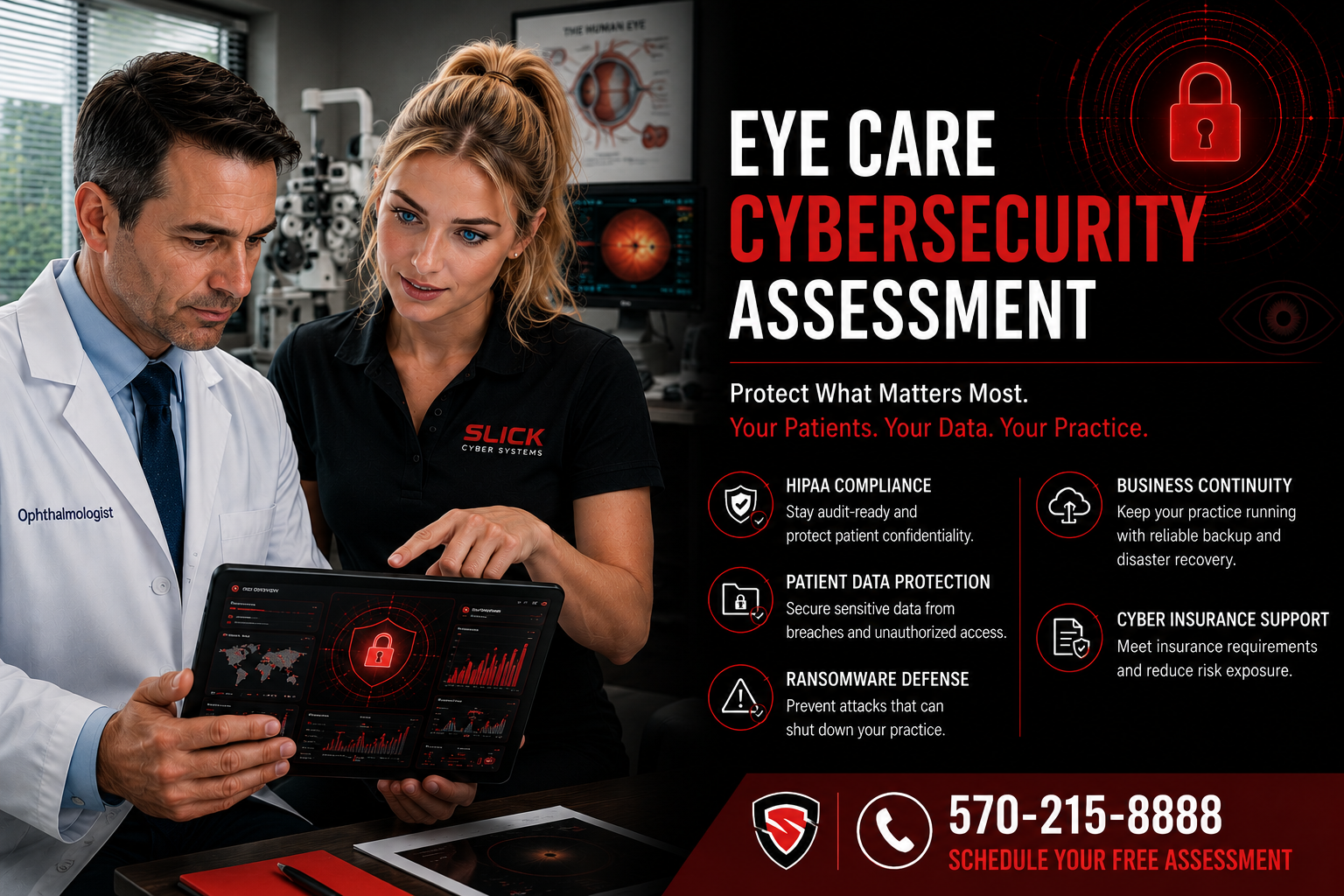
Eye Care Technology Assessment
Identify Technology Risks Before They Impact Patient Care
Most eye care practices don’t realize how many technology risks exist within their environment until they affect patient care, staff productivity, scheduling, or security.
During eye care technology assessments, we commonly identify 5-15 technology risks that impact operational efficiency, cybersecurity, compliance, and long-term growth.
From slow EHR systems and imaging performance issues to cybersecurity vulnerabilities and backup gaps, many problems remain hidden until they create disruptions.
The Eye Care Technology Assessment from Slick Cyber Systems helps optometry and ophthalmology practices identify risks, improve reliability, and create a roadmap for stronger operational performance before issues affect patients or staff.
Why Eye Care Practices Request a Technology Assessment
Technology environments change constantly.
New providers join the practice.
Additional locations are added.
New imaging equipment is installed.
Software updates occur.
Patient volumes increase.
Over time, these changes create hidden risks that affect performance, security, compliance, and operational stability.
Many practices request an assessment when they experience:
- Slow EHR performance
- Imaging system issues
- Recurring technology problems
- Cybersecurity concerns
- HIPAA compliance questions
- Microsoft 365 challenges
- Network reliability issues
- Wireless connectivity problems
- Practice growth and expansion
- Frustration with their current IT provider
Even when systems appear to be operating normally, hidden vulnerabilities often exist beneath the surface.
Our 7-Step Eye Care Technology Assessment Framework
1. Infrastructure Review
We evaluate servers, storage systems, network equipment, and supporting infrastructure to identify performance limitations, aging technology, and reliability concerns.
2. EHR & Practice Management Assessment
We review the technology supporting patient records, scheduling systems, billing platforms, and clinical workflows.
3. Diagnostic Equipment Connectivity Review
We assess the systems supporting imaging equipment, diagnostic devices, and integrations between clinical and administrative platforms.
4. Network & Wireless Assessment
We evaluate network performance, wireless coverage, and connectivity throughout the practice to identify bottlenecks and reliability issues.
5. Cybersecurity Risk Assessment
We identify vulnerabilities that could expose patient data, disrupt operations, or increase organizational risk.
6. Backup & Recovery Review
We assess backup systems, recovery capabilities, and disaster recovery readiness to ensure critical patient and business data remains protected.
7. Operational Risk Analysis
We identify single points of failure, unsupported systems, compliance concerns, and technology risks that could impact patient care and business continuity.
Common Issues We Discover
Many eye care practices are surprised by what we uncover.
Common findings include:
- Aging workstations affecting productivity
- Slow EHR performance
- Imaging system integration issues
- Wireless dead zones
- Security vulnerabilities
- Incomplete backup protection
- Inconsistent user access controls
- Unsupported hardware and software
- Capacity limitations
- HIPAA-related security concerns
Most of these issues can be addressed before they become major operational challenges.
Real-World Eye Care Examples
EHR Performance Issues
A growing optometry practice experienced recurring delays when accessing patient records. The assessment revealed aging infrastructure and storage bottlenecks affecting daily workflows.
Multi-Location Connectivity Challenges
An ophthalmology group with multiple offices discovered network configuration issues that were impacting communication and application performance between locations.
Cybersecurity Vulnerabilities
A specialty eye care practice identified several security gaps that increased exposure to phishing attacks and unauthorized access to patient information.
Is Technology Becoming Someone Else’s Job?
Many eye care practices do not have dedicated IT leadership.
Instead, technology responsibilities often fall to:
- Practice Managers
- Practice Administrators
- Office Managers
- Operations Directors
- Physician Owners
These individuals are expected to manage technology, vendors, cybersecurity, onboarding, and operational issues while also performing their primary responsibilities.
When technology becomes a secondary responsibility, important risks often go unnoticed until they impact patient care or business operations.
An Eye Care Technology Assessment provides the visibility needed to identify and address those risks before they become costly problems.
What You’ll Receive
Executive Summary
A clear overview of your technology environment and key findings.
Risk Identification Report
A prioritized review of issues affecting security, productivity, compliance, and operational reliability.
Improvement Opportunities
Practical recommendations designed to improve technology performance and reduce operational risk.
Strategic Technology Guidance
Recommendations aligned with your business goals, growth plans, and compliance requirements.
90-Day Action Plan
A prioritized roadmap for improving security, stability, and operational efficiency.
Why Eye Care Practices Choose Slick Cyber Systems
Eye care practices depend on reliable technology to support patient care, clinical workflows, scheduling, communications, and business operations.
Our team helps practices:
- Reduce downtime
- Improve EHR performance
- Strengthen cybersecurity
- Improve network reliability
- Support imaging technologies
- Strengthen HIPAA compliance efforts
- Improve business continuity
- Support practice growth
- Improve long-term technology planning
Our goal is simple:
Help eye care practices create technology environments that support patient care instead of disrupting it.
Is This Assessment Right for Your Practice?
This assessment is ideal for practices that:
- Have 15-250 employees
- Operate one or more locations
- Depend on EHR and imaging systems
- Have limited internal IT resources
- Want to improve cybersecurity
- Need greater visibility into technology risks
- Are planning growth or expansion
- Want to reduce operational disruptions
- Need strategic technology guidance
Schedule Your Complimentary Eye Care Technology Assessment
Technology problems rarely appear without warning.
Most disruptions begin as small issues that gradually become larger operational challenges.
An Eye Care Technology Assessment helps identify those risks before they impact patient care, productivity, compliance, or business growth.
Schedule your complimentary assessment today and gain a clearer understanding of your technology environment, operational risks, and opportunities for improvement.
Need Immediate Assistance?
Call (570) 215-8888
Or complete the form below to schedule your Eye Care Technology Assessment.