
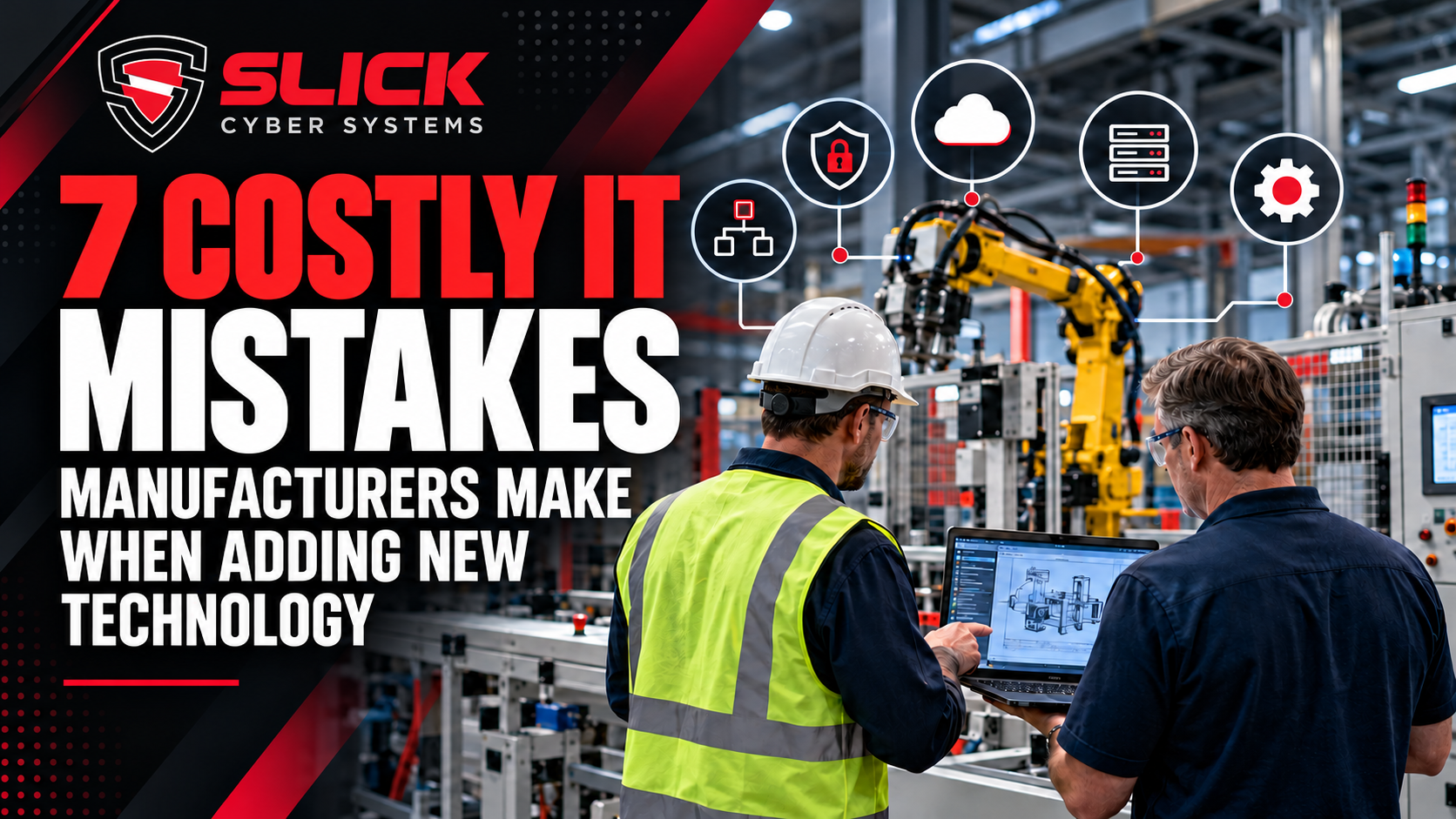
Manufacturing technology planning should happen before a new machine, application, or automation system arrives on your production floor. Too often, manufacturers buy technology first and ask IT to make everything work afterward.
That approach creates avoidable risk.
A new machine may need network access. New software may require more server capacity. Automation may depend on wireless coverage, databases, cloud connectivity, or vendor remote access.
The machine itself may work perfectly.
The environment around it may not.
The better question is:
Who owns the technology planning before new equipment, software, or automation becomes part of production?
1. Manufacturing Technology Planning Starts Before the Purchase
One of the most expensive mistakes manufacturers make is involving IT after the purchase.
Operations selects the machine.
Management approves the investment.
The vendor schedules installation.
Then someone asks IT to connect it.
By that point, important technical decisions may already be locked in.
Good manufacturing technology planning starts before the purchase whenever possible.
IT should understand:
- Network requirements
- Server requirements
- Wireless connectivity
- IP addressing
- Cybersecurity needs
- Remote access
- Backup requirements
- Software compatibility
- Database requirements
- Cloud connectivity
- Licensing
- Vendor support
- Business continuity
The goal is not to slow down the purchase.
The goal is to prevent the purchase from creating another operational problem.
2. Manufacturing Technology Planning Must Include the Network
A new machine or automation system can place demands on a network that was designed years earlier.
Manufacturers may add:
- CNC equipment
- Robotics
- Barcode systems
- Scanners
- Tablets
- Production terminals
- Cameras
- IoT devices
- Cloud applications
- Wireless equipment
Each addition increases network demand.
If the environment already has aging switches, poor wireless coverage, limited capacity, or unstable connections, new technology can expose those weaknesses quickly.
If your plant already experiences slow ERP access, dropped connections, or unreliable wireless, review the common causes of manufacturing network problems.
Do not assume the network is ready just because existing equipment still works.
3. Vendor Coordination Is Part of Manufacturing Technology Planning
Manufacturers often work with many technology vendors.
One supports ERP.
Another supports machines.
Another handles software.
Another provides internet service.
Another manages automation.
Each vendor understands its own product.
Nobody may own the complete environment.
That creates a dangerous gap.
The machine vendor may blame the network.
The software vendor may blame the server.
The IT provider may blame the application.
Meanwhile, operations waits.
Your business needs someone responsible for the whole environment, not just one product.
Slick Cyber Systems helps manufacturers coordinate across ERP vendors, equipment providers, cloud services, internet providers, and other technology partners through its IT services for manufacturing companies.
4. Ignoring Cybersecurity During Manufacturing Technology Planning
Every new connected system can create another cybersecurity risk.
Ask:
- Does the machine require internet access?
- Does the vendor require remote access?
- Does the system use default credentials?
- Can it support MFA?
- What network resources can it reach?
- Does it need to communicate with production servers?
- Does the vendor regularly patch the system?
- Who owns security updates?
- What happens when vendor support ends?
A machine should not automatically receive unrestricted access to the same network that supports finance, Microsoft 365, ERP, and other critical systems.
Manufacturers should evaluate cybersecurity requirements before connecting new technology.
Connectivity should follow business need, not convenience.
5. Manufacturing Technology Planning Must Include Capacity
New systems consume resources.
A manufacturing software implementation may require:
- More server capacity
- Additional storage
- Faster database performance
- Increased bandwidth
- New wireless infrastructure
- Additional switching
- New firewall rules
- Cloud connectivity
- Backup capacity
If the business does not evaluate those requirements beforehand, the new system may expose existing infrastructure limitations.
The problem can appear as:
- Slow ERP
- Application freezes
- Poor machine connectivity
- Wireless failures
- Network congestion
- Database performance problems
- Slow file access
A Manufacturing Technology Assessment can help identify capacity limitations, aging infrastructure, network reliability problems, and other risks before a new system goes live.
6. Manufacturing Technology Planning Must Define Support Ownership
Someone needs to own the system after implementation.
Do not wait for a failure to discover that nobody knows who supports what.
Before the system goes live, document:
- Who supports the hardware
- Who supports the application
- Who manages the network connection
- Who manages the server
- Who maintains the database
- Who handles cybersecurity
- Who manages backups
- Who contacts the vendor
- Who approves changes
- Who owns escalation
Without clear ownership, every problem creates delay.
Employees start making calls.
Vendors point at each other.
Operations loses time.
Manufacturing technology planning should define support ownership before production depends on the system.
7. Manufacturing Technology Planning Needs a Long-Term Strategy
The most serious mistake is treating every new technology purchase as an isolated project.
Manufacturing environments evolve continuously.
A new machine today affects:
- Network design
- Cybersecurity
- Server capacity
- Backup requirements
- Support responsibilities
- Future upgrades
- Capital planning
Another machine arrives next year.
A new ERP module follows.
Another cloud application gets added.
Eventually, the environment becomes a collection of individual decisions instead of a planned technology platform.
Strategic IT planning helps prevent that.
Slick Cyber Systems’ vCIO and IT consulting services can help with technology evaluation, vendor management, budgeting, and long-term planning.
The goal is not to make technology purchasing harder.
The goal is to make sure today’s purchase does not create tomorrow’s problem.
Manufacturing Technology Planning Should Start With Business Impact
Before evaluating technical specifications, understand why the business is making the investment.
Ask:
What problem are we solving?
What will production depend on after implementation?
What happens if this system fails?
How much downtime can we tolerate?
What technology does the system depend on?
Those answers help define the technical requirements.
They also help determine how much redundancy, monitoring, backup, and support the system needs.
A production-critical system deserves more planning than a noncritical application.
Use a Manufacturing Technology Planning Checklist Before Buying
Before approving a new machine, application, or automation project, involve both operations and IT.
Review these areas.
Network Requirements
Determine bandwidth, wired connectivity, wireless coverage, VLANs, IP addressing, and network security.
Server Requirements
Identify processing, memory, storage, database, and virtualization needs.
Cybersecurity Requirements
Review access, remote connections, credentials, patching, and vendor security.
Backup Requirements
Determine what needs to be backed up and how quickly it must recover.
Integration Requirements
Identify connections to ERP, databases, cloud services, inventory systems, or other production applications.
Vendor Responsibilities
Document who owns installation, configuration, maintenance, and troubleshooting.
Lifecycle Requirements
Understand expected support life, warranties, software support, and replacement timelines.
Planning these items before deployment reduces surprises during installation.
Manufacturing Technology Planning Must Address Remote Access
Equipment vendors frequently need remote access for maintenance or troubleshooting.
That can provide valuable support.
It also needs oversight.
Your team should know:
- Which vendors have remote access
- How they authenticate
- When they can connect
- What systems they can reach
- Whether access is monitored
- Who can disable access
- Whether access remains active when nobody needs it
Temporary vendor access should not quietly become permanent unrestricted access.
Manufacturing Technology Planning Must Include Backup and Recovery
Not every manufacturing system stores important data locally.
But many do.
New technology may create:
- Configuration files
- Databases
- Production records
- Recipes
- Quality records
- Machine settings
- Application servers
Determine what the business needs to recover before the system enters production.
Ask:
If this system fails tomorrow, what would we lose?
Then define the backup and recovery process accordingly.
Automation Makes Manufacturing Technology Planning More Important
Automation increases the connection between IT and production.
Machines, software, sensors, databases, networks, and cloud systems increasingly work together.
That creates efficiency.
It also creates dependency.
A problem in one supporting system can affect several operational processes.
Manufacturers should evaluate automation projects as both production projects and technology projects.
IT should not replace engineering or operations.
IT should make sure the infrastructure supporting the project remains reliable, secure, and recoverable.
Who Should Own Manufacturing Technology Planning?
The answer does not always need to be one employee.
Operations understands production requirements.
Engineering understands equipment.
Finance understands investment.
Vendors understand their products.
IT understands infrastructure, security, connectivity, support, and integration.
The business needs coordination across all of them.
Someone should own the process of asking:
Will this new technology work reliably inside our existing environment?
That is the missing responsibility in many technology projects.
Stop Adding Technology Without a Plan
New machines, software, and automation should improve production.
They should not introduce unexpected network problems, security weaknesses, server bottlenecks, support confusion, or downtime.
Before the next technology investment:
Involve IT early.
Check infrastructure capacity.
Review cybersecurity requirements.
Define vendor responsibilities.
Plan recovery.
Document support ownership.
Connect the project to the larger IT strategy.
Slick Cyber Systems helps manufacturers evaluate infrastructure, networks, business systems, vendors, cybersecurity, and technology capacity before operational problems appear.
If your plant plans to add new machines, software, or automation, schedule a Manufacturing Technology Assessment and identify the infrastructure and IT requirements before installation begins.




Leave A Comment
You must be logged in to post a comment.